


Bus AC Preventive Maintenance: A School Fleet Guide

Last Updated: November 13, 2026
Quick Summary
Bus air conditioning fails first in May, when warm weather and short, frequent door openings push roof units hard. Preventive maintenance, a full system check done before the heat arrives, catches weak airflow, short-cycling and slow compressors while repairs are still planned. Most fleets should service bus air conditioning once a year before the hot season.
- Schedule a full system check in late winter or early spring, before the first hot route.
- Inspect and clean the condenser fins, since packed debris forces the compressor to run longer.
- Time the pre-cool on each bus and log any drop in capacity across the season.
- Recharge only after finding the leak, because topping off without a repair buys only weeks.
- Keep a written log per bus so repeat failures show patterns worth acting on.
Table of Contents
- Why Bus Air Conditioning Fails First In May
- What A Standard School Bus AC Preventive Maintenance Check Covers
- How Often School Bus Air Conditioning Should Be Serviced
- School Bus HVAC Maintenance Checklist By Season
- Bus Air Conditioning Troubleshooting Guide For Drivers And Fleet Managers
- Book A Preventive Maintenance Plan For Your Fleet Before The Heat Arrives
- Frequently Asked Questions
Why Bus Air Conditioning Fails First In May
Most school bus air conditioners get their first real test in May. The weather turns warm, the buses sit in the sun before the first route, and the roof units start working hard on short runs where the door opens every few minutes.
At Custom Mobility, we see this every spring. The fix is rarely a surprise to the fleet manager, because the warning signs were there all winter: weak airflow, a unit that cycles on and off, a slow compressor, or a bus that needs a longer pre-cool than it used to.
Preventive maintenance is how a fleet gets ahead of that failure. It turns a May breakdown into a routine service visit.
What A Standard School Bus AC Preventive Maintenance Check Covers
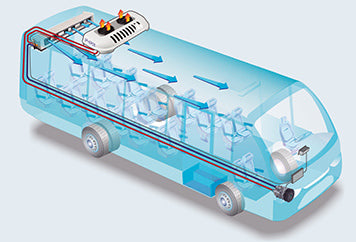
A proper bus air conditioning check covers the whole system, not just the cooling output. Our Bus/Vehicle AC Preventative Maintenance Services include diagnostics and recharge, compressor and condenser work, and evaporator service for roof units front and rear.
Every visit produces documentation you can keep with your DOT annual inspection and internal safety records.
If you want a clear picture of what your fleet needs, book a preventive maintenance plan for your buses. We come to your facility on your schedule.
How Often School Bus Air Conditioning Should Be Serviced
Most fleets should service bus air conditioning once a year, before the hot season starts. Buses that run long daily routes, or buses in the hottest parts of the state, benefit from a second check mid-summer.
A simple schedule works well for most fleets:
- Late winter or early spring: full system check, recharge if needed, condenser cleaning
- Early summer: airflow and cycling check, filter and blower inspection
- Fall: inspection before winter, documentation update for DOT records
- As needed: after any cooling complaint from a driver
Keep a written log for each bus. A log shows patterns, such as one unit that loses refrigerant every spring, and that pattern is worth acting on before it strands a route.
School Bus HVAC Maintenance Checklist By Season
A checklist earns its place only if each line tells the technician what to look for and what a bad result means.
Spring, before the first hot route
- Pull the condenser and look through the fins against a light. Fins bent flat or packed with debris block airflow and force the compressor to run hotter and longer. Straighten or clean before the first 90-degree day.
- Check static refrigerant charge and run a leak trace on every joint, Schrader valve and hose crimp. A system that is low in March will be lower in June.
- Watch the compressor clutch engage. A clutch that slips or engages late is a warning, not a nuisance.
- Test every blower speed, not just high. A blower that only runs on high usually has a failed resistor pack, and drivers will not report it until the bus is full.
- Inspect drive belts for glazing and cracks, and check tension at the spec for the unit.
- Confirm the evaporator drain is clear. A plugged drain puts water on the floor and rots the housing.
Summer, during the heat
- Time the pre-cool on each bus. A unit that took four minutes in April and takes nine in July is losing capacity, and the driver will feel it before the gauge shows it.
- Look for ice on the evaporator coil or suction line. Ice means restricted airflow or a charge problem, and it will not fix itself.
- Check electrical connectors at the compressor and blower for corrosion and heat discoloration.
- Log every driver complaint by bus number and time of day. A pattern by route or by time is diagnostic.
Fall, before winter
- Review the season log for repeat offenders. One bus that lost charge twice is a leak you have not found yet.
- Update the maintenance file for the DOT annual inspection. Documentation is part of the job.
- Schedule any deferred repair now, while the shop is not chasing May breakdowns.
Winter, planning and parts
- Set next year's service dates against the route calendar, not the calendar on the wall.
- Order known wear items early: belts, filters, clutch assemblies, resistor packs. A part on the shelf in March is a route saved in May.
Watch out: a checklist that gets signed without the technician actually looking through the condenser fins is worse than no checklist, because it creates a paper trail that says the bus was inspected. A sign-off tied to what the technician actually observed makes it easier to keep recurring inspections consistent, whether the work is handled in-house or informed by DIY GARAGE maintenance scheduling practices.
If you want a schedule built around your routes and your shop's capacity, book a preventive maintenance plan for your buses and we will map the seasons to your calendar.
Bus Air Conditioning Troubleshooting Guide For Drivers And Fleet Managers
A driver who knows three checks can save a fleet manager a wasted shop visit. A fleet manager who reads the log correctly can save a route. The two jobs are different, and the guide below splits them.
What the driver should do before writing up the bus
- Confirm the fan is actually on the speed the driver thinks it is. A blower stuck on low feels like weak cooling and is a resistor pack, not a refrigerant problem.
- Note the outside temperature and the time of day. A unit that cools at 7 a.m. and quits by 2 p.m. is telling you something specific about airflow and heat soak.
- Listen at the compressor. A clutch that clicks in and out every few seconds is short-cycling, and that is a charge or pressure switch issue, not a blower issue.
- Write the bus number, the symptom, the time, and the route on the tag. A vague complaint costs the shop an hour of diagnosis.
What the fleet manager should read from the pattern
A unit that blows warm from the first minute usually has low refrigerant, a failed compressor clutch, or a blend door stuck on heat.
What not to do
Do not top off refrigerant without finding the leak. A recharge without a leak repair buys weeks, not a season, and it puts the same bus back on the side of the road in July.
When to call a technician
Call when the pattern points to refrigerant, the compressor, or the condenser, and call before the bus is scheduled for a route the next morning. Start a service plan for your fleet and we will set up a schedule that fits your routes.
The article splits the first checks by who is doing them, so this table lists each symptom with what it usually points to and the fix.
| Symptom | Likely cause | Fix |
|---|---|---|
| Blows warm from the first minute | Low refrigerant, failed clutch, or blend door stuck on heat | Find the leak, then recharge |
| Cools but weak | Clogged evaporator or failing blower | Inspect evaporator and blower |
| Blower runs only on high | Failed resistor pack | Replace resistor pack |
| Clutch clicks in and out every few seconds | Short-cycling from charge or pressure switch | Check charge and pressure switch |
| Recharged three times in two seasons | Leak the shop has not found | Run a leak trace with dye or electronic detector |
Book A Preventive Maintenance Plan For Your Fleet Before The Heat Arrives
May comes early in Georgia, and a bus that fails on a Monday morning leaves a route uncovered. A preventive plan costs far less than a stranded route and a rush repair. Tell us how many buses you run and when they go out, and we will build a schedule around it.
Call Custom Mobility to set up your fleet's air conditioning plan before the first hot week arrives.
Frequently Asked Questions
How often should school bus air conditioning systems be serviced?
Most fleets schedule preventive maintenance on the air conditioning before the hottest months, then check it again at mid-season. Buses on short routes with the door opening every few minutes work their compressors harder, so those vehicles tend to need attention sooner. Custom Mobility's Bus/Vehicle AC Preventative Maintenance Services, at $135.00, are scheduled on-site at your facility, so a pre-season visit can be set around your route calendar rather than the other way around.
What are the most common causes of school bus AC failure?
Low refrigerant and a worn compressor clutch are common causes, and both show up as warm air at the vents. Condenser fins clogged with road dust and leaves cut airflow and make the system work harder. Evaporator issues and electrical faults round out the list. Most of these are found early by a scheduled check and are much cheaper to fix than a unit that quits on a loaded afternoon route.
What is included in a standard school bus AC preventive maintenance check?
A proper check covers diagnostics and a refrigerant recharge where needed, along with compressor and condenser work and evaporator service. Every visit should produce documentation your team can keep with DOT annual inspection records. Custom Mobility's bus A/C work follows that same scope and is performed by EPA Section 609 certified technicians.
Does regular AC maintenance affect school fleet operating costs?
It does, mostly by keeping vehicles out of the shop. A unit that is checked on schedule is less likely to fail during a route, which means fewer emergency calls, fewer replacement vehicles pulled from service, and less overtime for drivers who have to be reassigned. Scheduled service also spreads the expense across the year instead of landing it as one large repair bill in the middle of summer.
Related Articles


Need Help Choosing?
Our mobility specialists can help you find the perfect solution.
Get a Free Consultation
Tell us what you need — we'll handle the rest.
Ready to Regain Your Independence?
Schedule a free, no-obligation consultation with one of our mobility specialists today.
Get Your Free Consultation